
A network of Riveros Corp
Inside the United States nobody asks for it, yet the rest of the world requires it. We request your Certificate of No Record of Marriage — the official certificate of single status — directly from Florida Vital Records, and we handle its international apostille. Therefore, you neither lose time in bureaucratic procedures nor risk a rejection for filing the wrong document. Bilingual service, in person in Brickell (Miami) or fully remote.
Review of your destination country’s requirements, with a first reply within 24 business hours.
Commissioned Florida Notary Public · Document Preparers (nonlawyers) · Fully bilingual Spanish · English · In person in Brickell or online (RON)
Florida Notary Public commissioned by the Governor of Florida under Chapter 117 of the Florida Statutes.
We verify exactly which document the civil registry or consulate where you will marry requires, before we file anything.
Legal names, year ranges and forms are checked before you pay any non-refundable state fee.
Apostilled document, translated if your country requires it, dispatched by tracked courier anywhere in the world.
The civil registry in your country asks for a “certificate of single status,” but the United States has no national civil registry and no federal marriage database. As a result, you do not know which office to approach — and the consulate does not explain it.
If you go to the Miami-Dade Clerk of Court, the resulting record covers that county alone: you could have married in Broward, Palm Beach or any other jurisdiction. For a foreign government, that margin of uncertainty is unacceptable.
Personal affidavit or government search certificate: each country requires one, the other or both. Choosing wrongly — or notarizing what must not be notarized — sends your file back weeks later, with the wedding at risk.
Between the state search, the apostille and international mail, every error costs weeks. Therefore, you need someone who knows the process to execute it correctly the first time, even while you are outside the U.S.
A Certificate of No Record of Marriage is the public, administrative document behind every certificate of single status. In Spanish it is known as certificado de soltería. In it, the Bureau of Vital Statistics of the Florida Department of Health searches its consolidated databases for a specific range of years. The office then certifies officially that no marriage record was found in the applicant’s name. It does not rest on the applicant’s word. Instead, it rests on the empirical result of a search performed by the government custodian of the records. For that reason, it carries the greatest legal weight as documentary evidence. Consulates, foreign civil registries and immigration authorities worldwide accept it to prove single status or Freedom to Marry.
Since 6 June 1927, this centralized state repository has held every marriage processed in Florida counties. It is the closest analogue to a central civil registry that exists in the U.S.
Within the United States, no county will ask you for proof of single status in order to issue a marriage license: your signature on the application is enough. International family law, however, works very differently. Foreign civil registries have a duty to prevent polygamy and to verify that you are legally free to marry. Because the U.S. federal government keeps no unified marriage register, the most solid and internationally respected solution is a state search certificate. Notary Public Center is a private entity of Riveros International Business Corp, with an office in Brickell, Miami. We review the requirements of the country where you will marry. Then we determine whether you need the state certificate, the sworn affidavit or both. We file the application with the Florida Bureau of Vital Statistics. Finally, we coordinate the apostille, the certified translation and tracked delivery to your door.
In U.S. legal practice there are two main ways to prove single status, and both are colloquially called “Single Status”. Choosing the wrong one can mean the rejection of your file abroad.
This is a private document: a written declaration in which you state under solemn oath that you are not married and that no legal impediment prevents you from marrying. To be valid it must be signed exclusively before a notarial officer, who administers the oath (through a certificate known as a Jurat) and verifies the declarant’s identity unambiguously.
When it is used: when the destination country accepts the applicant’s sworn declaration. It is a fast procedure — in person at our offices or by Remote Online Notarization (RON) from anywhere in the world.
Its limit: many nations with strict civil registries consider it insufficient, because it is only your word. Before the apostille, this document DOES have to be notarized.
This is the public, administrative document. It does not rest on the individual’s statements. Instead, it rests on the actual search that the State of Florida runs through its historical files, with a certified result of “Not Found” for the years investigated. Because it is a government document based on public records, it carries greater evidentiary weight before courts and foreign registries that are skeptical of personal declarations.
When it is used: when the destination country requires official government proof — the highest standard of documentary evidence, common in European jurisdictions to mitigate the risk of marriage fraud.
Critical warning: this certificate must NEVER be notarized before the apostille — it already carries the state registrar’s signature, and adding a notarial act causes immediate rejection.
The choice between one document or the other — or the submission of both — depends exclusively on the legal requirements of the destination country. The biggest mistake people make when planning an international wedding is filing the wrong document, and that mistake can mean the rejection of the whole file. At Notary Public Center we review the specific requirements of the country where you will marry. That way we process exactly what you need. If it requires the state certificate, we obtain it from Vital Records. If the embassy also requires a sworn affidavit, our team prepares it and a Florida Notary Public notarizes it.
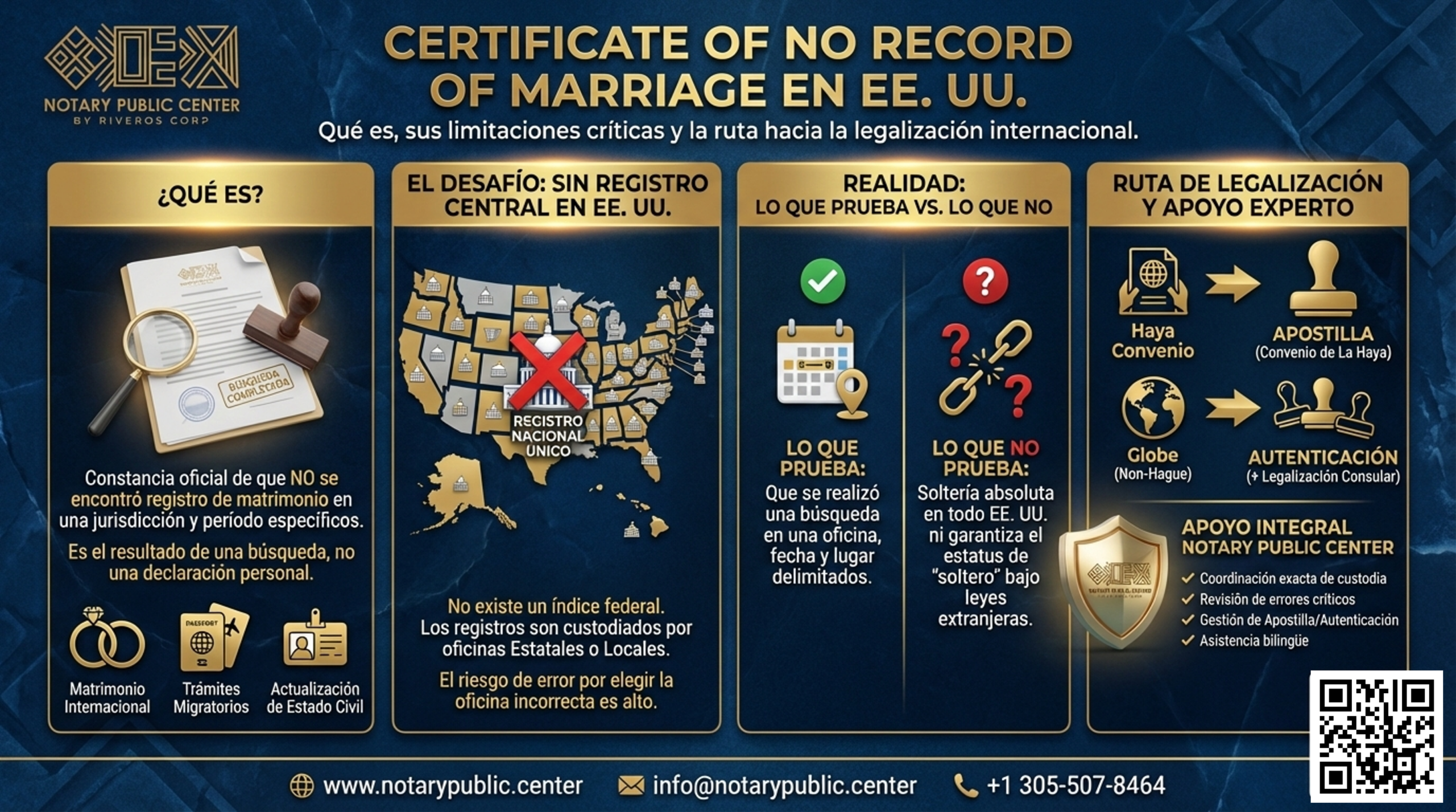
Latin America and Europe centralize civil status acts nationally. The U.S. system, by contrast, delegates marriage registration to the local authorities of each county, typically the Clerk of Court’s office. If you request proof of single status in Miami-Dade, that record certifies only that no entry exists in that specific county. For a foreign government this is insufficient, because you could have married in the neighboring county. Florida law solves the problem. After each ceremony, the officiant returns the marriage license to the Clerk of Court. The county then has a duty to send a copy of the record to the Bureau of Vital Statistics, part of the Florida Department of Health in Jacksonville. There it is filed and consolidated permanently, in a transfer that takes about 60 days on average.
That is why our state search covers every Florida county since 6 June 1927. A certificate of single status issued at state level removes any jurisdictional ambiguity. Your document then carries the certainty that foreign civil registries demand.
Any U.S. civil status certificate is invalid abroad without international legalization. For countries party to the 1961 Hague Convention, the final step is the Apostille, issued in Florida by the Secretary of State’s office. For non-member nations the chain is more complex: state authentication, federal authentication before the U.S. Department of State in Washington D.C., and final legalization at the embassy or consulate of the destination country. Here lies a bureaucratic trap that ruins thousands of files: many people try to notarize their original Vital Records certificate before sending it for apostille. That is a serious error. The vital record already carries the signature of a state public official, and the Apostille authenticates that signature directly. A notarial act on top of it invalidates the document, and the Department of State rejects it.
The treatment is exactly the reverse for the Single Status Affidavit. That one DOES have to be notarized first, because the Apostille authenticates the signature and seal of the notarial officer. Our specialists know these protocols and route each document to the correct authority, protecting your investment of time and money.

We reduce administrative friction through a process structured in four phases, with strict protection of your personal information (PII): encrypted transmission, least-privilege access and limited retention.
We identify exactly what the civil registry, consulate or authority of your destination country requires. That covers the state certificate, the sworn affidavit or both, the validity period and the language. So we file the right thing the first time.
We complete the application to the Florida Bureau of Vital Statistics with your exact legal names and the correct year range. In addition, if your case requires the Single Status Affidavit, we prepare it and a Florida Notary Public notarizes it — in person in Brickell or by video call (RON).
We file the application and the fees with Vital Records, monitor the state search until the “Not Found” certificate is issued, and resolve any additional requirement raised by the authorities.
We handle the Hague Apostille before the Secretary of State. For non-member countries we follow the consular authentication chain instead. We also coordinate the certified translation if required, and dispatch your document by tracked courier to your door, in any country.
The operational integrity of Notary Public Center rests on complete financial transparency. Your quote sets out precisely the statutory fees the government requires. They include a fee for the initial search and charges for each additional calendar year investigated. Our professional fees for file preparation, notarial acts and logistical handling appear separately. The table below shows the items that make up your case; the exact amount of each one is given to you in writing in your quote, before we start.
| Charge category | Description of the service or fee |
|---|---|
| State search fee | Official Bureau of Vital Statistics charge for searching the records over the requested year range and issuing the certificate. It is a mandatory, non-refundable government fee — even when the result is “Not Found,” which is precisely the result you need. |
| Additional search years | Government charge for each additional calendar year included in the search, according to the range your destination country’s authority requires. |
| Document preparation fees | Covers the professional service of Notary Public Center: destination country review, form preparation, verification of legal names, filing of the application, continuous follow-up and dedicated bilingual support. |
| Notarization of the Single Status Affidavit (if applicable) | Notarial act on the sworn declaration of single status — in person or by video call (RON) — at a fee regulated by the State of Florida. Only when your destination country requires it. |
| Apostille or consular authentication handling | Processing of the international legalization before the Florida Secretary of State (Hague Convention) or of the state–federal–consular chain for non-member countries, including official duties. |
| Certified translation (optional) | Certified translation of the issued certificate, when the destination country’s civil registry requires it, coordinated within the same order. |
| Logistics and international shipping | Secure dispatch of the finished document through trackable couriers (FedEx, UPS, DHL) to protect the chain of custody, calculated by destination. |
Procedural legal note: vital records offices apply a “non-refundable search fee” policy. Fees change without notice and vary with the year range and the services your country requires. For that reason we do not publish amounts: we confirm the exact, current breakdown of each item in writing in your quote, before you pay anything.
If you are already outside the United States — or live in another state — you do not need to travel to Florida to complete your case. We file the application with Vital Records on your behalf. Furthermore, your file may require the Single Status Affidavit. Remote Online Notarization (RON) then lets you sign and swear it by video call. Florida authorized it in January 2020. The session runs on encrypted audio and video, with biometric credential analysis, knowledge-based authentication (KBA) and tamper-evident recording. You appear before our Florida Notary Public, with legal validity in all 50 states. Afterwards we continue the process with the government, handle the apostille and send you the final document — translated if your country requires it — by tracked courier to your door.

Unlike anonymous internet portals, we offer a tangible multidisciplinary team: compliance officers, signing agents and a Florida Notary Public. Strict protocols of encryption, least-privilege access and limited retention protect your personal information (PII).
We work daily with the Bureau of Vital Statistics and county offices. As a result, we know what each jurisdiction requires, which year range to request and how to avoid rejections.
Russia, Brazil, China, Colombia, Spain or Mexico: each civil registry requires a different document. Therefore, we review your specific case before filing anything.
We receive clients in person at 175 SW 7th St, Ste 1905, in the heart of Miami's financial district — we are not an anonymous internet portal.
Encrypted sessions with biometric verification and KBA, so you can notarize your sworn affidavit from any country in the world.
Fully bilingual service: the process is explained in plain Spanish and the forms are completed in the technical English the government requires. We also coordinate the certified translation of the final certificate.
We separate government fees (non-refundable by law) from our professional fees — with a full written quote before we start.
4.9 out of 5 — 720 verified Google reviews
Notary Public Center, Miami
“Good and courteous service, friendly staff, always on time.”
★★★★★ — Google review
“Highly professional, clean environment in a central location.”
★★★★★ — Google review
No. Courts and counties inside the United States do not require this document to issue a local marriage license; your signature on the application is enough. It becomes strictly necessary outside U.S. territory. There, foreign authorities do require documentary proof of freedom to marry, whether you register a marriage, start consular procedures or pursue immigration processes.
It is the colloquial name for two different documents. The first is the Single Status Affidavit, a personal sworn declaration signed before a notarial officer. The second is the Certificate of No Record of Marriage. In it, the state government searches its consolidated files and confirms that no marriage record exists in your name. Which of the two you need (or whether you need both) is determined by the country where you will marry; that review is the first phase of our service.
Legally, the certificate of single status confirms that the State of Florida — the jurisdiction consulted — found no record in your name during the specified dates. Because the U.S. has no national register, foreign countries accept the search of the state of residence as valid proof of civil status. If you have lived in several states, some authorities may request searches in each one; we check this during the initial review and coordinate any additional applications needed.
The affidavit is a private document. You declare under oath, before a notarial officer, that you are not married. It is quick to obtain, but it is only your word, and several nations with strict civil registries consider it insufficient. The search certificate is a public document: the State of Florida actually investigates its historical files and issues a certified “Not Found” result, with greater evidentiary weight abroad. Countries such as Russia, Brazil, China and Colombia have very specific guidelines on which one they accept, and in many cases European jurisdictions require the official Vital Records document.
The most common reasons are four. The first is filing a sworn affidavit when the country required the government search certificate, or the other way round. The second is a discrepancy between the names on the application and those on the passport. The third is an insufficient search year range. The fourth is notarizing an original public vital record. A Vital Records certificate already carries the state registrar’s signature, and the Apostille authenticates that signature directly. Adding a notarial act therefore causes immediate rejection by the Department of State. Our service removes these risks.
No — under no circumstances. This is the most common bureaucratic trap in the process. The certificate issued by the Bureau of Vital Statistics carries the signature of a recognized state registrar and is apostilled directly. The treatment is the reverse for the Single Status Affidavit. That one does have to be signed before a notarial officer before it goes to the Secretary of State. There, the Apostille authenticates the signature and seal of the notarial act. We route each document along the correct path.
The central repository of the Bureau of Vital Statistics consolidates marriages processed in every Florida county since 6 June 1927. The search behind your certificate of single status runs for the year range you request, normally the one the authority of your destination country requires. Bear in mind that a very recent marriage may take time to appear: transferring the record from the county to the state archive takes about 60 days on average.
The cost divides into two parts. The first is the government fees: the initial search fee, the additional years investigated and apostille duties, all non-refundable by law. The second is our professional fee for review, preparation, notarization where applicable, and handling. Fees change without notice and depend on the year range and the services your country requires. For that reason, we give you the full written quote, with every item itemized, before we start. There are no hidden fees.
Absolutely. You have the right to request the certificate directly from the Florida Bureau of Vital Statistics, paying only the government fees. Our private, independent service suits those who prioritize convenience. It also suits anyone who needs certainty that the file meets the exact requirements of the destination country. Finally, it suits anyone who needs the full chain of apostille, certified translation and international delivery without errors or delays.
Yes. We file the certificate of single status application with Vital Records on your behalf. If your file requires the Single Status Affidavit, it is signed by video call through Florida-authorized Remote Online Notarization (RON), with biometric verification and validity in all 50 states. Finally, the completed document — apostilled and translated if your country requires it — is sent to you by tracked courier to your door, in any country.
Yes, but your file changes: in that case foreign authorities usually require, in addition to the state search, the certified final divorce decree with an apostille. During the initial review we go through your complete civil history and confirm in writing the exact combination of documents your destination country will accept.
No, and be wary of anyone who offers to. Only the government agency that holds the records — the Bureau of Vital Statistics of the Florida Department of Health — has authority to run the search and issue the certificate. Our role as a private service is different. We review your country’s requirements and prepare the correct application. We notarize the sworn affidavit where applicable. Then we handle the government procedure and coordinate the apostille, the translation and the delivery.
Yes. The whole service is bilingual: we assist you in Spanish or English by WhatsApp, phone or at our Brickell office. In addition, an international wedding file usually needs more documents — the birth certificate, the divorce decree or the marriage certificate from a previous union. We handle them all in the same order, with the same apostille and shipping chain. Visit our Vital Records hub or write to us with your consulate’s list.
This service forms part of our Vital Records hub in Miami. If your marriage file requires more documents, we also handle the apostille of U.S. documents and the affidavits your consulate requests.
Our vital records hub: birth, marriage, death, proof of life and more.
Certified copy of your U.S. marriage certificate, with international handling.
Preparation and notarization of affidavits in Florida, in person or online (RON).
Retrieval and notarization of your U.S. birth certificate in all 50 states.
Avoid serious delays caused by badly processed documents. Write to us on WhatsApp with the country where you will marry. We review the requirements of your file and confirm which certificate of single status your civil registry requires. Then we give you the full written quote, with no obligation and in complete confidence.
175 SW 7th St, Suite 1905, Miami FL 33130 · Mon–Fri 9:00–17:00 ET · +1 305 507 8464 · info@notarypublic.center
By contacting us, you acknowledge that this business provides clerical document-preparation and Florida Notary Public services. We are not attorneys, we do not provide legal advice, and we are not a government agency.
I AM NOT AN ATTORNEY LICENSED TO PRACTICE LAW IN THE STATE OF FLORIDA, AND I MAY NOT GIVE LEGAL ADVICE OR ACCEPT FEES FOR LEGAL ADVICE.
Private Entity and Non-Affiliation Notice: Notary Public Center and its parent company, Riveros International Business Corp, form a private commercial corporation. It is dedicated to administrative handling, international legalization of documents and notarization services. We are not a government entity, court or law enforcement agency. We are not affiliated with, endorsed by, or operating on behalf of the Bureau of Vital Statistics, the Department of Health or the Department of State. The same applies to any other vital records office of the United States or its territories. Individuals have the absolute right to deal directly and independently with state or local health agencies. Government offices provide blank vital record application forms free of charge. Any citizen may file an application directly, paying only the statutory fees those agencies set. Our fees reflect compensation for logistical expertise, identity authentication, procedural guidance and expedited handling before those entities.
Unauthorized Practice of Law (UPL) Disclaimer: Notary Public Center is not a law firm, and no member of our team acts as legal counsel or attorney. All of our document-preparation services are provided strictly as administrative self-help assistance, based exclusively on the specific directions and factual information supplied by the consumer. Florida law and the applicable regulations categorically prohibit us from practising law or issuing legal opinions. We may not predict the outcome of judicial proceedings, and we may not advise on legal rights, strategies, defenses or the legal sufficiency of any form. Engaging our administrative services does not, under any circumstances, establish a confidential attorney–client privileged relationship. Some situations involve complex custody disputes, cross-border inheritance rights or legal determinations of parentage affecting vital records. In those cases, you must consult an attorney duly licensed in the relevant jurisdiction.
Third-Party Data and Technology Responsibility Policy: in accordance with applicable federal regulations, transmitting your application may involve third-party platforms. They include identity validation services such as the biometric verification and knowledge-based authentication operated by LexisNexis or Proof, formerly Notarize, and government payment gateways. While we maintain rigorous perimeter security standards, interaction with those portals is governed by the independent privacy policies and terms of service of those technology providers. Notary Public Center disclaims all non-contractual liability for incidents arising from data processing by government infrastructure or from interruptions in the availability of state services.
Limitation of services (Nonlawyer Disclosure): this business operates solely as a Legal Document Preparer and provides Florida Notary Public services. Our services consist of procedural self-help under the consumer’s specific direction. We are not licensed to practice law, cannot predict outcomes, do not explain legal options or rights, and information shared with us is not protected by attorney–client privilege.
Family law: if your matter involves Florida Supreme Court Approved Family Law Forms, the law requires us to provide the Disclosure from Nonlawyer form (Form 12.900(a)) for your signature before assisting you.
Translation of titles: in accordance with Florida Statute §117.05(11) and HB 915, this business does not translate the title “Notary Public.” We are not civil-law notaries, immigration consultants, or immigration specialists.